

What These Imitation Foods Are Actually Made Of
Foods, particularly mass-produced, packaged, and widely distributed grocery store items and restaurant offerings, are rarely just one thing. Most of the things we all eat on a daily basis consist of a great number of ingredients that have been carefully selected, mixed, and assembled to make something palatable, delicious, nutritious, and familiar. But then there's marketing, the umbrella concept by which all pre-made food is presented to the world.
Marketing affects a product's packaging and advertising, and in order to get as many people as possible to buy that can, box, or entree, food companies can and will be a little bit dodgy. Products are often not exactly what they seem, with the much-touted ingredients, place of origin, or the food itself not quite aligning with what the box or menu says that it is. A surprisingly high number of commonly purchased and consumed items are actually other, less attractive, cheaper, or lab-created foods in disguise. Here are some of the frequently faked foods — and what they really are.
Imitation blueberries
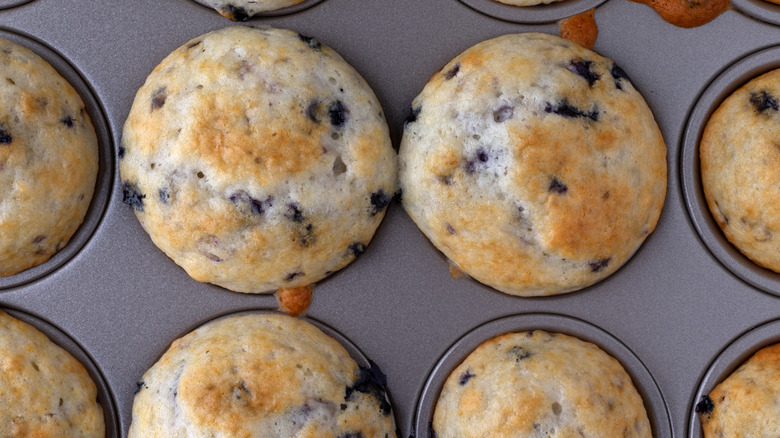
Blueberries are delightful little treats. Both growing wild and on farms, they're not too sweet, they're one of nature's few naturally blue (or bluish foods), and a handful packs a nutritional wallop, offering high levels of healthy fiber and antioxidants. They're also a versatile ingredient, the star of stuff like blueberry waffles, blueberry scones, and blueberry muffins. But check the ingredients list on blueberry baking mixes and ready-to-eat blueberry treats, because it's highly likely that the nature's candies within aren't really blueberries.
Those sweet, blue nuggets in cereal, bagels, muffins, and bread are usually made up of sugar, corn syrup, starch, oils, synthetic flavoring agents, and, to get the color right, red and blue food dyes. If the "blueberries" aren't completely fake, then food makers sometimes use a scant amount of tiny dried blueberries combined with their convincing artificial counterparts.
Truffle oil

Truffles, a fungus similar in biological makeup and flavor profile to mushrooms, are one of the hardest-to-get ingredients in the world. They can't be cultivated and grow underground in only a few regions around the globe, rooted out of the ground by specially-trained pigs and dogs. A few shavings are all a chef or home cook needs to impart truffles' remarkable flavor, which is fortunate, because authentic truffles are extremely expensive, with prices reaching into the thousands of dollars per pound realm.
One way food producers have tried to meet the curiosity and demand for this highly sought-after, exclusive, and exotic ingredient is with truffle oil, a more cost-efficient way to add the taste and zing of the buried treasure to dishes like truffle fries. But this "fancy" ingredient is usually bogus. Even high-end restaurant chefs have been fooled by truffle oil, which was viewed as a miracle ingredient and thought to be made by steeping real truffles in olive oil. Most of the time, it's not — truffle oil is made by combining olive oil with synthetic chemical compounds and derivatives, such as 2,4-dithiapentane.
Cinnamon
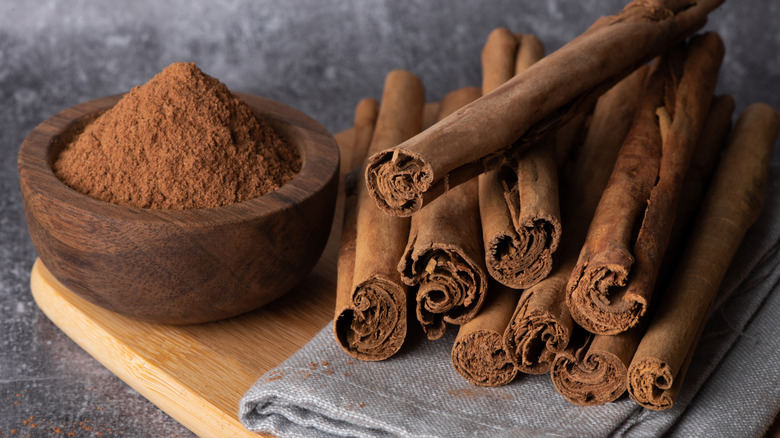
Cinnamon isn't just a flavor that resides at the corner of sweet and spicy — it's a specific preparation of a particular plant. Strips of the inside bark of the Cinnamomum verum tree are dried until they form rolls — those are cinnamon sticks. Those are then ground into a powder to create cinnamon that can be spooned or sprinkled, or it's further processed to create a genuine cinnamon extract. While it's often called cinnamon, after its source tree, the authentic spice is also known as Ceylon cinnamon, and it's native to southern India and Sri Lanka, which was once known as Ceylon.
And then there's cassia, a.k.a. Chinese cinnamon, because it's a product of the China-native Cinnamomum cassia tree. It's able to grow in many more places than Ceylon cinnamon relative, and it's a major cash crop across eastern and Southern Asia. Nearly all supermarket cinnamon is really cassia, not Ceylon cinnamon.
Canned pumpkin purée

Pumpkin pie is a can't-skip festive food for millions during the late-year holiday season, appearing on grocery store bakery shelves and family dinner tables from Halloween all the way through Thanksgiving and until Christmas. It's a signature food that reflects the historical harvest period for its dominant ingredient. All those affordable store-bought pumpkin pies, as well as the homemade pumpkin pies made with relative ease in home kitchens across the land, are made with canned pumpkin purée, a mass-produced and commonly available ingredient thanks to companies like Libby's, which distributes enough of the stuff to make 90 million pies each year.
Libby's calls its big moneymaker "100 Percent Pure Pumpkin," even though it isn't really that at all. The U.S. Food and Drug Administration lacks strict rules about what can legally be called "pumpkin," allowing Libby's and other companies to market its canned concoctions with the "pure" signifier. Actual pumpkins — those orange behemoths found in patches and turned into jack o'lanterns — are too watery, stringy, and lacking in sweetness and flavor to easily make into pie-ready purée. So, pumpkin canning companies use a combination of pumpkin-like winter squashes, blending Golden Delicious, Hubbard, and butternut squashes. Libby's uses the Dickinson squash, a plant it helped develop to meet its needs, and it's a close relative of butternut squash — not the pumpkin.
Wasabi
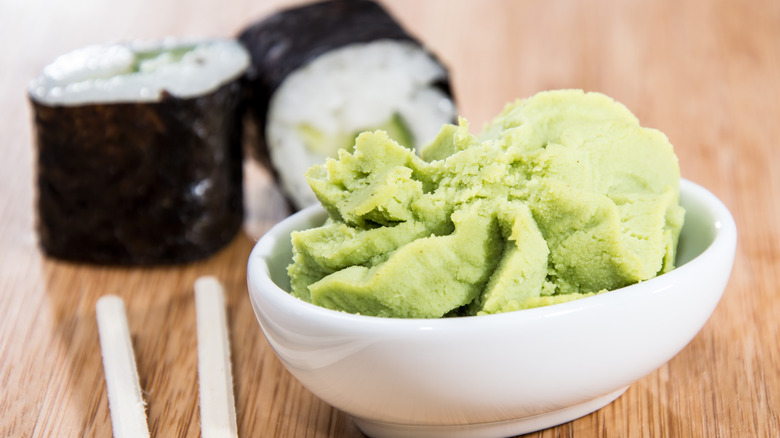
In Japanese restaurants in the U.S., sushi in all of its forms, like maki rolls or sashimi, comes with two standard garnishes/condiments: palette-cleansing pickled ginger slices and a dollop of bright-green wasabi, a paste best consumed in very small doses because it's face-meltingly spicy. It tastes (and delivers a punch) like horseradish because it is horseradish. Real wasabi is made out of grated Wasabia Japonica root, but the wasabi accompanying sushi orders in sushi bars in America (as well as elsewhere in the world, including Japan) is overwhelmingly unlikely to be authentic wasabi from the Wasabi Japonica plant.
The majority of the global supply of wasabi paste is made out of European horseradish, a plant that's easy and cheap to grow in many climates. The rhizome of the plant (which is a relative of Wasabia Japonica) is ground up and combined with a particular green food dye to make it resemble (and taste like) authentic wasabi. This is all done largely out of necessity. Real wasabi is extremely difficult to grow, requiring its roots to stay in water and needing a cold climate and a lack of direct sunlight to properly mature, which takes the better part of two years. It's tough to grow, and tough to export, too, leaving Japanese restaurants around the world to make do with the reasonable facsimile of dyed horseradish.
Vanilla extract
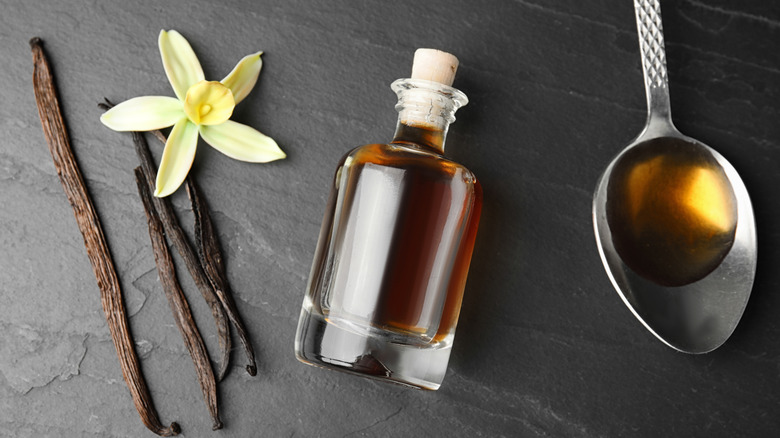
Lurking on spice racks across the country, laying in wait to add a pop of rich, sweet, and creamy flavor to desserts and baked goods, are tiny brown bottles of vanilla. Containers of real vanilla extract and imitation vanilla look identical, but the contents inside are extremely different.
About 80% of the global vanilla crop originates in Madagascar, and vanilla extract is made by soaking long, brown vanilla bean pods in alcohol and collecting the pure vanilla that comes out in the process. Alcohol is also involved in the creation of imitation vanilla. It's used to dilute the vanilla-like substance created by processing vanillin out of guaiacol, a petroleum derivative. Caramel color is added to make it resemble natural vanilla extract. Real vanilla is both rare and expensive. Only 1% of all vanilla sold is authentic, with the rest the fake stuff, which costs about 50 times less than the real deal.
Caviar
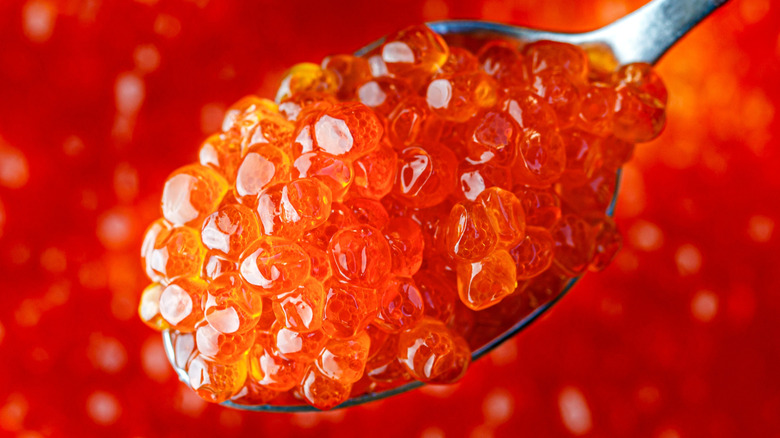
Traditionally a hallmark of Russian cuisine, caviar earned a reputation as one of the fanciest, most exclusive, and priciest foods out there. True caviar, historically speaking, is the roe — eggs — of female wild sturgeon, caught and processed around the Caspian Sea and the Black Sea in Eastern Europe. Those areas were so severely overfished in the 1980s and 1990s that what was once known as authentic caviar became harder to come by, and thus more expensive, and there wasn't enough to meet global demand for the salty eggs served with sour cream on blinis. Black, sturgeon-based caviar was joined in the marketplace by fish eggs labeled as caviar that came from trout and salmon, both wild-caught or farmed, and in colors like red, gold, and brown.
In the 2020s, caviar sold at less-than-astronomical prices outside of nice restaurants and specialty grocery stores is very likely to have been harvested from a pregnant trout, salmon, or other common fish, and not a Black Sea sturgeon. While not technically caviar, those are at least real fish eggs, unlike some faux-caviar alternatives. Imitation caviar is very different to the real thing, made with seafood extracts, gelling agents, and dyes, and can even be vegan.
Honey
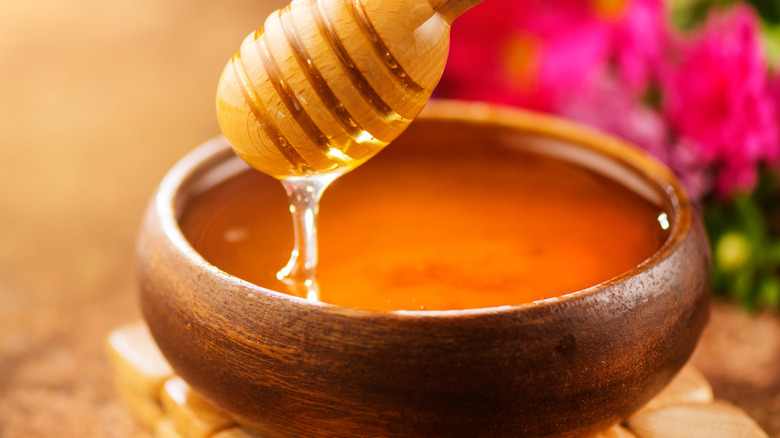
KFC purports to offer homestyle cooking, like fried chicken, mashed potatoes, and biscuits, serving the latter with packets of butter and honey. Well, sort of — the butter is a margarine called Buttery Spread while the Honey Sauce contains just a small amount of honey. It may taste almost exactly like honey, but apart from that small portion of the real stuff, KFC's food scientists use six other sweeteners— high fructose corn syrup, corn syrup, sugar, fructose, and molasses — and some coloring agents to create its faux bee product.
Because of food labeling laws, KFC is at least honest about its not-quite-honey posing as honey. Imitation or adulterated honey constitutes a massive, fraudulent industry. It's one of the most-faked foods on a global scale, and in 2013, the U.S. Justice Department filed charges against importers Honey Solutions and Groeb Farms for bringing in impure honey. Like the KFC packets, operations substitute cheaper high fructose corn syrup (or beet syrup) for the more expensive real honey or use chemically modified sugars to make the industrially produced sweeteners resemble honey.
Maple syrup is similar to honey and it's similarly faked. Real maple syrup will say so on the bottle and on its ingredients list. If the product, generally a mass-produced one like Mrs. Butterworth's or Pearl Milling Company, is designated "pancake syrup," it's because it has ingredients other than maple sap taken from trees. Many pancake syrups have no actual maple syrup in them.
Subway's tuna

A cheap and hearty source of low-fat protein, tuna serves as the star of the tuna sandwich, prepared at home or appearing on the menu of sandwich shops, mixed with mayonnaise and veggies. Subway has long offered a tuna sub at its thousands of locations, but it wasn't until the 2020s that questions arose over if the sandwich actually contained any real tuna.
In 2021, California-based Subway customers Karen Dhanowa and Nilima Amin filed a lawsuit, alleging that the tuna subs didn't contain any tuna, which was a problem because they felt fooled into paying extra for sandwiches made with the product which they believed was healthier than other meats. The story went viral, and The New York Times investigated, purchasing three tuna subs from three different Subway outlets. A reporter took out the meat and sent it to a food testing lab, which analyzed the genetic makeup of the protein, according to Forbes. According to the lab's report, "No amplifiable tuna DNA was present in the sample," though that didn't necessarily mean there was no tuna in the samples. However, in another test, traces of DNA were present for beef, pork, and chicken. Subway dismissed the complaints and tried to get the lawsuit thrown out of court, and other tests found that Subway's tuna was, in fact, tuna. The case continues to drag on without a resolution.
Premium seafood

Not only is the tuna in a prevalent fast food tuna sandwich possibly not tuna, but it might not be the real thing at more upscale establishments either. In 2013, the conservation nonprofit Oceana published the results of a two-year analysis of 1,200 fish samples obtained by sushi parlors across the U.S. According to Ocean's DNA tests, one-third of the fish samples were not what menus purported them to be. Especially fraudulent were tuna and red snapper. About 60% of fish proclaiming to be tuna were not tuna, and 87% of red snapper was nothing of the sort — it was another fish altogether.
And while lobster is a relatively expensive food item that carries with it an air of luxury and prestige, it's curiously and seemingly common, sold at mainstream, middle-of-the-road sit-down restaurants like Red Lobster and fast food chains such as Long John Silver's. Both have sold seafood labeled as lobster, but it's not really that shellfish. Big chains make major use of the very cheap, lobster-masquerading langoustine, sometimes called "langoustine lobster." It's not a variety of lobster — it's a mixture of various, inexpensive crab and shrimp parts.
As for grouper, a favorite fish of fine dining establishments, it's also often fraudulent. According to an investigation by the Florida state attorney general's office (via The New York Times), restaurants were caught serving cheap, imported seafood, like tilapia, hake, bream, and green weakfish, and passing it off as grouper.
Extra virgin olive oil

One of the most common and far-reaching fake foods in the United States today is extra virgin olive oil, which is used for a variety of cooking and food preparation purposes in home kitchens and restaurants of all levels. Even the chefs who use what they think is EVOO and the home cooks who buy it in major grocery stores aren't aware that what they're pouring isn't authentic.
A whopping 80% of the global extra virgin olive oil market consists of fraudulent or adulterated products. Some nefarious distributors — who charge at high EVOO prices — dilute real olive oil with inexpensive and widely-produced alternatives, like peanut oil or soybean oil. According to The New Yorker, a federal raid of a New Jersey warehouse in 2006 yielded 61,000 liters of EVOO and 26,000 liters of lower-quality olive oil. A great deal of it, bound for widespread distribution, consisted entirely of soybean oil.
Pancake syrup
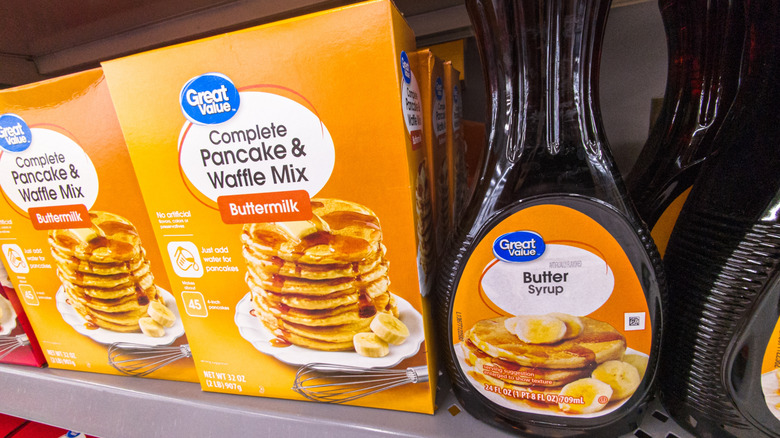
Just because the bottle looks like maple syrup does not mean it's the good stuff. Imitation maple syrup, sometimes called "pancake syrup" or "maple-flavored syrup," is actually made from corn syrup, cane sugar, and artificial flavors. The deep brown color is still there, the sweetness is still there, but true maple fans can taste the missing flavor. That said, pancake syrup is still syrup. It's an imitation food that isn't being manipulated too much to achieve its final form. It's just that the final form is an imitation of a specific type of syrup that people actually want to put on pancakes.
Now, we've all been hungry enough — and had pancakes good enough — that the difference between maple syrup and pancake syrup becomes immaterial. At a certain point, pancakes just taste good. Especially with the right mix of crunch and fluffiness? Oh, and don't forget a generous pat of butter. Still, we have a handy guide if you want to know how to make sure maple syrup is real.
Whipped topping

When you read the name of this product, you'll notice that "topping" is not a word that in any way suggests dairy. That's because whipped topping is made primarily from hydrogenated vegetable oil, water, and sugar. That's great if you're looking for a non-dairy ingredient. There are plenty of other advantages to using whipped topping, too — it has stabilizers that help maintain consistency for longer than whipped cream, and it also has less fat than whipped cream. The trade-off, of course, is that whipped topping is a more processed ingredient than whipped cream. It also has a lot more sugar. Still, the fact that it's a non-dairy option holds appeal for anyone with a dietary restriction.
Then again, some whipped toppings are made with a little bit of dairy. Some may include pasteurized cream and nonfat milk, but are still marketed as whipped topping, because they don't contain enough cream to legally be called whipped cream. If you're not held back by any dietary restrictions, this discrepancy comes down to a matter of taste. If you're buying whipped topping because you don't eat dairy, though? Well, you don't want to learn the hard way that you've made that mistake. Make sure to read the ingredient label on any whipped topping if you or your guests have problems with dairy foods.
Vegan butter

This stuff comes in many different forms, but one thing is constant with vegan butter: It's a dairy-free product that's made completely without animal byproducts. From there? Well, vegan butter can be made in a few different ways, and different brands take different approaches. The three near-universal types of ingredients are vegetable oil, nuts, and seeds. When those are combined, other flavorings can start to come into play. Different companies will throw in things like salt, nutritional yeast, and various herbs to add depth of flavor.
If you're looking for what brand of vegan butter to buy? The answer to that question kind of depends on the taste that you're looking for. Something like Melt might be on the more oily side, whereas Flora is creamier and saltier, and Earth Balance is noted for its subtlety. Maybe you want different brands for different applications, like you find that Earth Balance performs really well in baking, whereas Melt tastes great on toast. Not all butter made from animal products is created equally, and neither is vegan butter.
Impossible and Beyond Meat burgers

Both Impossible and Beyond Meat made quite a splash when the products were introduced. Here was a plant-based product that looked, cooked, and tasted closer to meat than anything humans had come up with before. Immediate questions arise when you see these products in action: First, what's the difference between Beyond Meat and Impossible Burger? Second, just what are these things made of, anyway?
Impossible burger patties are a mixture of many ingredients, like soybean protein, coconut and sunflower oils, and an array of seasonings. The secret weapon hidden inside Impossible burgers, though? That's soy leghemoglobin, or heme, an iron-rich molecule found in the proteins of every living plant and animal. We humans contain heme, and we like to eat heme, it seems. Impossible gets heme from fermented yeast. That stuff, as it turns out, is easy to manipulate into producing precise waste products that make food taste good. This process isn't unlike how Belgians make beer, and it allows Impossible to make plant-based meat at scale.
Beyond burgers, on the other hand, rely more heavily on protein from peas, lentils, rice, and faba beans. For binding, Beyond uses plant starches and oat bran, and somewhat famously, that meaty red color in Beyond burgers comes from beets. Beyond Meat's products are essentially a way of doing the classic veggie burger, but doing it in a way that appeals to meat lovers.
Just Egg vegan eggs
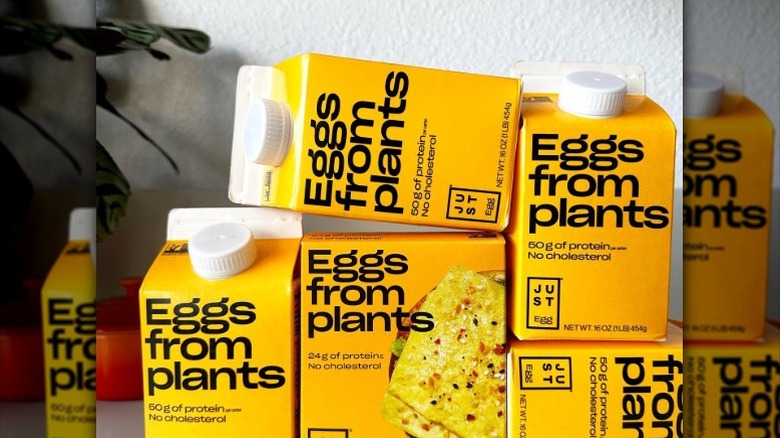
Available in stores ranging from Walmart to Whole Foods, Just Egg is a vegan liquid egg substitute made from mung bean protein, water, and canola oil. There are plenty of reasons to eat vegan egg substitutes that don't even require being vegan. For one, no more fishing cracked pieces of shell out of your eggs. For another, given that a serving of Just Egg has four grams of fat, five grams of protein, and zero grams of cholesterol? If you're asking yourself whether it's healthy to eat too many eggs, maybe throw in some Just Egg every now and again.
"How does it taste, though?" we can hear vegans and non-vegans alike asking. It's a fair worry, as the specific joys of chicken eggs are hard to replicate. Just Egg gets a lot of praise for not only tasting like chicken eggs, but behaving similarly while cooking, as well. Your plate of Just Egg should have some bounce, like the kind of texture you'd get from a well-done scrambled chicken egg.
Margarine

What's in margarine? The answer varies. The classic butter alternative is usually, but not always, dairy-free. It's sometimes even vegan. Margarine is made from vegetable oils, water, and an array of various ingredients like salt, natural and artificial flavorings, and colorings. The main oils used are palm, palm kernel, and soybean oil. There's good news about what margarine no longer contains, too: Since 2015, margarines have gotten rid of trans fats.
You may or may not be able to believe it's not butter, but one thing to be wary of is that margarine is not always dairy-free or vegan. Sometimes, a manufacturer will use milk or other animal products like whey in margarine. If margarine does contain any milk products, the manufacturer is required by law to warn customers on the packaging. As with many products, it's important to read ingredient labels. Hey, some margarines even contain omega-rich oils, which can actually be good for cardiovascular health. Knowing what exactly is in the food you buy can make a real difference.
Imitation crab meat

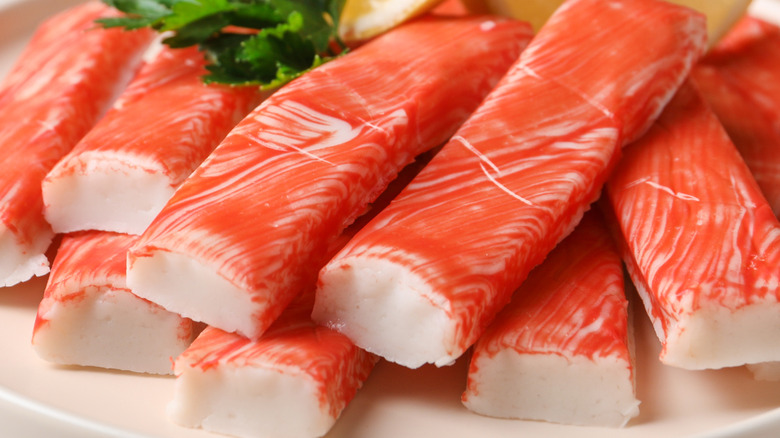
Crab is expensive, but it's delicious, so food producers have tried to meet demand for the delicately flavored meat of the crustacean with imitation crab, also marketed and sold under less blunt and more obtuse names like "crab stick" and "krab." It's generally sold in grocery stores' seafood counters right alongside its authentic inspiration, often in airtight packages that show off its recognizable white-and-red stripes — uncannily re-creating the color of crab meat and crab shell, respectively.
Imitation crab is not made with much actual crab meat, nor even any distantly related shellfish, as it's made primarily from an industrially processed fish product called surimi. This is made from actual fish, in the form of a cheap and plentiful whitefish, such as pollack. This is pounded and turned into a pliable paste, the surimi, which constitutes anywhere between one-third and one-half of the imitation crab product. The rest of the stuff is a mixture of starches, water, vegetable oil, egg whites, soy, sugar, and lots of salt.